

![[ENG] - Karpervissen in Denemarken met Danny en Peder - KarperCentrale](http://www.carpcentral.com/cdn/shop/articles/eng-karpervissen-in-denemarken-met-danny-en-peder-9525938.png?v=1785226059&width=10)
A Danish carp adventure on big water
Carp fishing on a big, wild water demands preparation, adaptability, and plenty of perseverance. At Lake Sorø in Denmark, Danny Fairbrass and Peder Lichtenberg face exactly that challenge.
The water covers over 1,000 acres and holds only a limited carp stock. The banks are lined with reeds and vast lily beds, while wind, rain, and long distances make fishing extra tough.
The goal for this Thinking Tackle session is modest at first: catch one Danish carp. Still, Danny and Peder know there are big, old fish swimming around. To connect with them, they have to keep searching, moving, and adapting their gear to the conditions.
Starting out in a large bay with lily beds
The first swim is in a spacious bay with large fields of lilies. At first glance, the spot looks very inviting. The cover, shallow water, and weed offer carp several safe routes.
At the same time, that weed makes fishing tricky. The middle of the bay is very soft and likely full of silt and filamentous weed. Closer to the plants, there are harder, shallower spots, but you have to keep a hooked carp quickly away from the lilies there.
Before casting out, Danny and Peder discuss how to spread their rods. One rod goes along a reed bed, another in the middle of the lilies, and a third on the far side of the bay. Peder spreads his own rods across the open water.
Using a depth sounder to locate carp
Peder uses a depth sounder to check the bottom and possible fish activity. On the screen, he sees several large shapes with clear shadows.
With his experience, he can interpret the shape, position, and shadow of the signals. He believes there are several big fish. For Danny, who’s less familiar with this kind of gear, it’s eye-opening to see how much info a good depth sounder can provide.
A depth sounder doesn’t automatically tell you where to fish. It’s mainly a tool to spot depth changes, hard patches, weed growth, and possible fish activity. You still need to check if your rig can be safely and effectively presented there.
Adjusting gear for tough European carp fishing
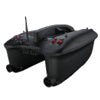
Danny quickly discovers that some of his usual gear isn’t up to the job for this session. The long distances, fishing from the bait boat, and heavy weed demand much tougher tackle.
He replaces his lighter leaders with 30 lb Kontour Kamo. This thicker material is more resistant to plants and obstacles. As mainline, he uses 15 lb sinking braided line, which offers a lot of strength and sinks well.
For the leaders, Danny chooses a heavy coated material with a breaking strain of 50 lb. This gives him more confidence when a carp swims through the lilies or moves along obstacles.
The banksticks and bite detection are also adjusted. The rods are placed far into the water and must be firmly supported. Light gear that works well under normal conditions can bend or come loose here.
Different lead systems for different bottoms
The bottom determines which lead system Danny uses. Around the lilies, the bottom is soft and contains a lot of organic material. There he chooses a helicopter rig.
With a helicopter setup, the leader can be placed higher on the mainline. This allows the lead to sink further into the soft bottom without pulling the rig completely down.
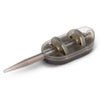
On a hard bottom, Danny switches to a heavy COG system. He uses a 6 oz lead weight loaded from the center. As soon as a carp stretches the leader, the resistance quickly goes from almost nothing to the full weight of the lead.
The choice between these systems is therefore not determined by preference alone. The firmness of the bottom and the way the rig lands are decisive.
Strong spinner rigs for lilies and reeds
Danny has a lot of confidence in spinner rigs. For this session, he makes the rig extra strong to suit the conditions.
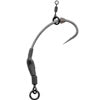
He uses a size 2 Long Shank X-hook combined with heavy coated leader material. The long shank helps the hook turn quickly. The straight point is aimed at direct hooking.
A 0.4 gram weight is placed on the hook. This makes the hook point heavier. As soon as the hookbait is taken, the point wants to turn downwards and make contact with the bottom lip.
A spinner rig also has the advantage that the hook can be replaced quickly. This is important during boat fishing. Danny prepares several hooks with hookbait and hook weight in advance and stores them in the boat.
A stiff hair for large hookbaits
For the hookbait, Danny uses a 30 lb Arma-Kord hair. This stiff braid stays neatly in place and is less likely to tangle.
This is important because large hookbaits are used and other fish can move the presentation. A very soft hair can then wrap around the hook or end up in the wrong position.
With the stiffer material, the presentation remains effective even after the bait has been inspected multiple times. As soon as a carp appears, the rig must still hook well.
Snowman presentations by Peder
Peder fishes with a snowman presentation. He combines a hardened fishmeal boilie of 24 millimeters with a striking pop-up treated with King Crab.
By placing the pop-up above the heavy bottom boilie, a partially balanced hookbait is created. The carp can take it more easily, while the size helps make the rig more selective and robust.
Peder uses a supple 30 lb N-Trap Soft rod. Because he places his rigs on harder spots in open water, he can fish with a lead clip setup.
His confidence in these hookbait types is based on previous results on similar large and lightly stocked waters.
Casting rigs accurately with the boat
Casting out a rig seems simple, but on big water every action must be done carefully. The wind can quickly push the boat and line sideways.
Peder advises to head slightly upwind with a crosswind when returning to the spot. As the boat moves toward the bank, the wind gradually straightens the line. Once back at the rods, the line can be tightened without a big curve over the water.
In some spots, the braided mainline is held above the lilies with a pole. When a carp takes the bait, the line initially stays out of the plants.
Additionally, captive backleads are used to quickly sink the line close to the bank. This reduces the chance that recreational boats or other water users go through the lines.
Boat preparation prevents costly time loss
During the first days, Danny notices he hasn’t laid out everything he needs in the boat. A missing swivel or spare hook can mean having to go all the way back to shore.
That’s why he prepares a special boat set. In a bucket, he keeps lead, backleads, spare parts, and ready-made hooks with hookbait. He also takes a multitool, scissors, and towel.
After a bite, the fish can be held in or beside the boat while a new hook is attached and the rig is reset. Only then do they head back.
At a spot 100 to 300 meters away, this saves a lot of time and physical effort.
The first Danish carp
After about 24 hours, Peder gets the first real bite of the session. The fish is played from the boat and safely landed.
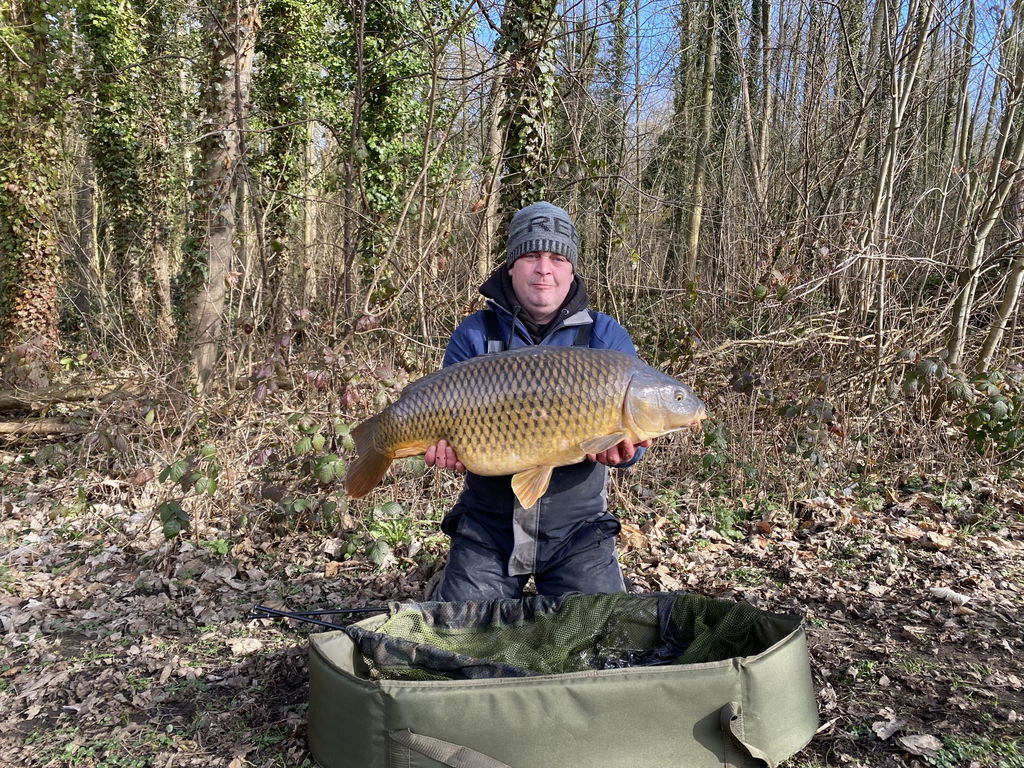
The carp weighs 9.3 kilos. On a water with a small stock, every catch is a big result. The first goal of the session is thus achieved.
The bite comes around last light, after a few carp were spotted earlier in the area. This confirms the fish did visit the zone, even though it took a long time before a rig was actually picked up.
Still, Danny and Peder decide not to stay automatically. One catch doesn’t yet mean there’s a big group of carp present.
When should you move on big water?
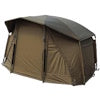
Moving on a big lake is a major operation. The bivvies, boats, rods, and all other gear have to be packed up and transported over long distances.
That’s why Danny only wants to move when there’s a clear reason. Peder sees it differently. If a spot shows hardly any signals after a full night, he prefers to keep searching.
Their conversations show there’s no fixed rule. On one hand, you don’t want to leave just before the carp arrive. On the other, stubbornly staying put can cost you the whole session.
Important signals are visible fish activity, bites on multiple rods, info from other carp anglers, wind direction, and what you see on the depth sounder.
Searching with boat, depth sounder, and drone
When the first spot yields little, Peder and the team explore different parts of the lake. They check bays, deep hard patches, and large weed beds.
Not every promising spot shows clear carp signals. In deeper water, fish are also harder to spot on the depth sounder.
Later, a group of carp is accidentally found with the drone. On a water body over 1,000 acres, it’s almost impossible to thoroughly check every zone from the bank.
The drone is therefore used as an extra scouting tool. It remains important not to disturb other carp anglers and recreational users.
Opportunistic fishing along lily beds
After finding carp on the far side, the team moves again. The new spot offers access to lily beds, reed beds, and various obstacles.
Danny places his rigs about a rod length away from the lilies. He wants to fish close enough to intercept passing carp, but not so close that every bite turns into a dangerous situation.
There’s little baiting going on. This isn’t an open water tactic where you build a big baited area. The rods are laid out as individual traps along likely routes.
One of the rods is baited with tiger nuts. Danny has a lot of faith in this bait and expects almost every carp to take a well-presented tiger nut.
An unexpected carp over 50 lb
At the new spot, Peder gets a bite again. At that moment, he’s checking out another zone himself, so Danny picks up the rod.
The fight turns into a chaotic operation. The boat has to head back to shore because the landing net is missing, and then the motor gets tangled in weeds. Eventually, they manage to free the line and land the carp.
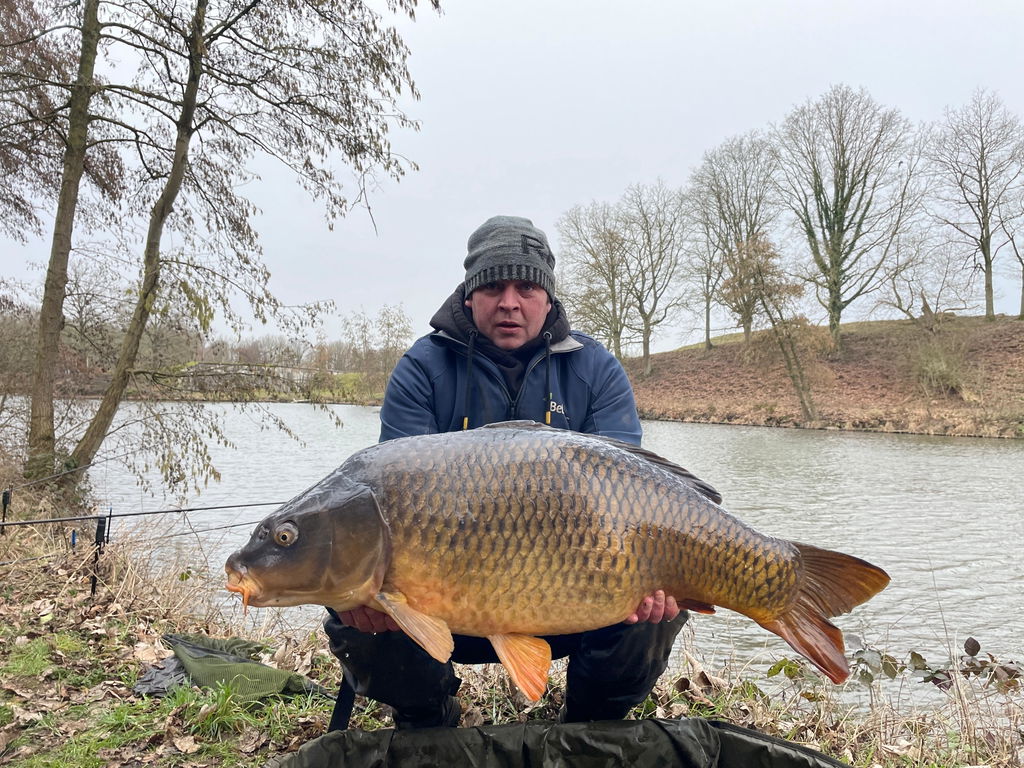
The old mirror carp weighs 50 lb and 8 oz. It’s one of the biggest fish in the water and exactly the type of wild Danish carp they came for.
Although Danny picks up the rod and lands the fish, he sees the catch as a team effort. Peder found the spot, set the rig, and trusted his proven bait presentation.
Why a strong fluorocarbon leader is necessary
The large mirror carp swims through the lilies during the fight. With steady pressure, the fish is eventually pulled out of the plants.
The 30 lb Kontour Kamo leader plays a key role here. The material is thick and abrasion-resistant enough to move past obstacles, yet can cut through lily stems when the line is under tension.
A leader that’s too thin would wear out faster in these conditions. Choosing the wrong material can cost you a fish and create an unsafe situation where the carp is left trailing line and rig.
Always match your leader to the plants, stones, branches, and the distance you’re fishing.
Refining hook length and rig mechanics
Danny and Peder both use hooklinks about six inches long independently. This length offers enough movement without allowing the carp to shift the bait far before feeling the lead.
Danny pays close attention to the turning properties of his hook. The Long Shank X quickly rotates into a hooking position thanks to its long shank.
The 0.4 gram shot-on-the-hook helps position the point towards the lower side of the mouth. A sinker in the middle of the hooklink keeps the rig lying against the bottom.
The hooklink is steamed before use to stretch it out. Danny also pulls every knot very tight. A knot must be able to withstand more strain during preparation than a carp can apply during the fight.
Short leaders are more practical when fishing from the boat.
Danny uses roughly fifteen feet of fluorocarbon as a leader. In the past, he fished with much longer lengths, but that proved impractical.
When the mainline slackens, a long, stiff fluorocarbon leader can slip off the reel spool. This quickly causes loops and knots.
He keeps about one and a half rod lengths to maintain protection around the rig while keeping the setup manageable.
This is a clear example of how experience on big water leads to practical adjustments. More gear doesn’t automatically mean safer or better.
The final move to the windward side
Despite multiple catches, Danny himself goes long stretches without a carp. After five days of boating, setting rigs, and relocating, the session starts to take a mental toll.
Peder eventually locates carp on the opposite side of the lake, where the wind pushes the water against reed beds and lily fields. He lands another carp there and spots several fish moving.
With about 24 hours left, the team decides on one last move. The wind grows stronger, causing high waves across the large lake.
Thanks to Peder’s large aluminium bait boat, the rigs can still be placed safely. The rods are spread out across the bay to cover different routes.
Four carp during the last night and morning
In the dark, a bite finally comes on one of Danny’s rods. The bait boat is steered through reeds and lily pads. Peder frees the line by pulling loose several plant stems.
The first carp weighs 35 lb. After five days without a bite, the relief is huge.
It doesn’t stop there. During the morning, three more carp follow, including fish of 26 lb, 38 lb, and 38 lb 4 oz.
A session that seemed like a blank for a long time turns into an exceptional result within a few hours. The carp are indeed present in numbers, but only at the last spot are the rigs placed exactly on their route.
What do you learn from this Thinking Tackle video?
This video shows how crucial preparation is when carp fishing on big water. Boat gear, spare parts, strong leaders, and ready-made rigs must be well organized beforehand.
Additionally, you learn how Danny and Peder adjust their lead system to soft and hard bottoms. The helicopter setup is used on soft spots, while a heavy COG system is deployed on harder ground.
Locating carp also plays a key role. Depth sounder, drone, visual observations, wind direction, and information from other anglers are combined to choose new areas.
The most important lesson might be not to be afraid to move on a vast water. One lone catch doesn’t always mean you’ve found the group. When several rods stay quiet, a new spot can change the entire session.
Teamwork makes the difference
Danny emphasizes at the end of the session how much difference Peder’s knowledge and effort have made. The Danish carp angler knows the challenges of large wild waters and how to accurately place rigs from the boat.
During the catches, teamwork is equally important. One person steers the bait boat while the other holds the rod or frees the line from weeds.
The cameramen and Peder’s family also contribute to the final result. On waters like these, a successful session is rarely built entirely alone.
The trip to Denmark not only reveals remarkable carp but also how much trust, teamwork, and perseverance are needed to succeed on a large, sparsely fished water.